A practical exercise in astrometry — orbit determination based solely on my own observations of the long-period comet C/2025 R3 (PanSTARRS).
In April 2026 the comet passed through the inner solar system. It came in from the Oort cloud on an orbit with a period of about 170,000 years, but the attraction of the planets has now sent it out on an open orbit. It is an object mankind will never see again. For teachers of astronomy and physics such an event is a unique "natural laboratory" for working with classical mechanics and uncertainty calculations together with students.
So I set myself a goal: could I, using only my Unistellar eVscope 2 telescope and an advanced AI language model, calculate the comet's true physical distance and velocity in space? And even more importantly — could we validate the AI's calculations by cross-checking them directly against the official databases of NASA and ESA?
Three nights above Marshøj
Data were collected from Marshøj near Gjerrild, Denmark (56 °N, 11 °E) over three nights. On the first two nights the comet was sharp — on the third the sky was unfortunately covered by light cloud and mist.
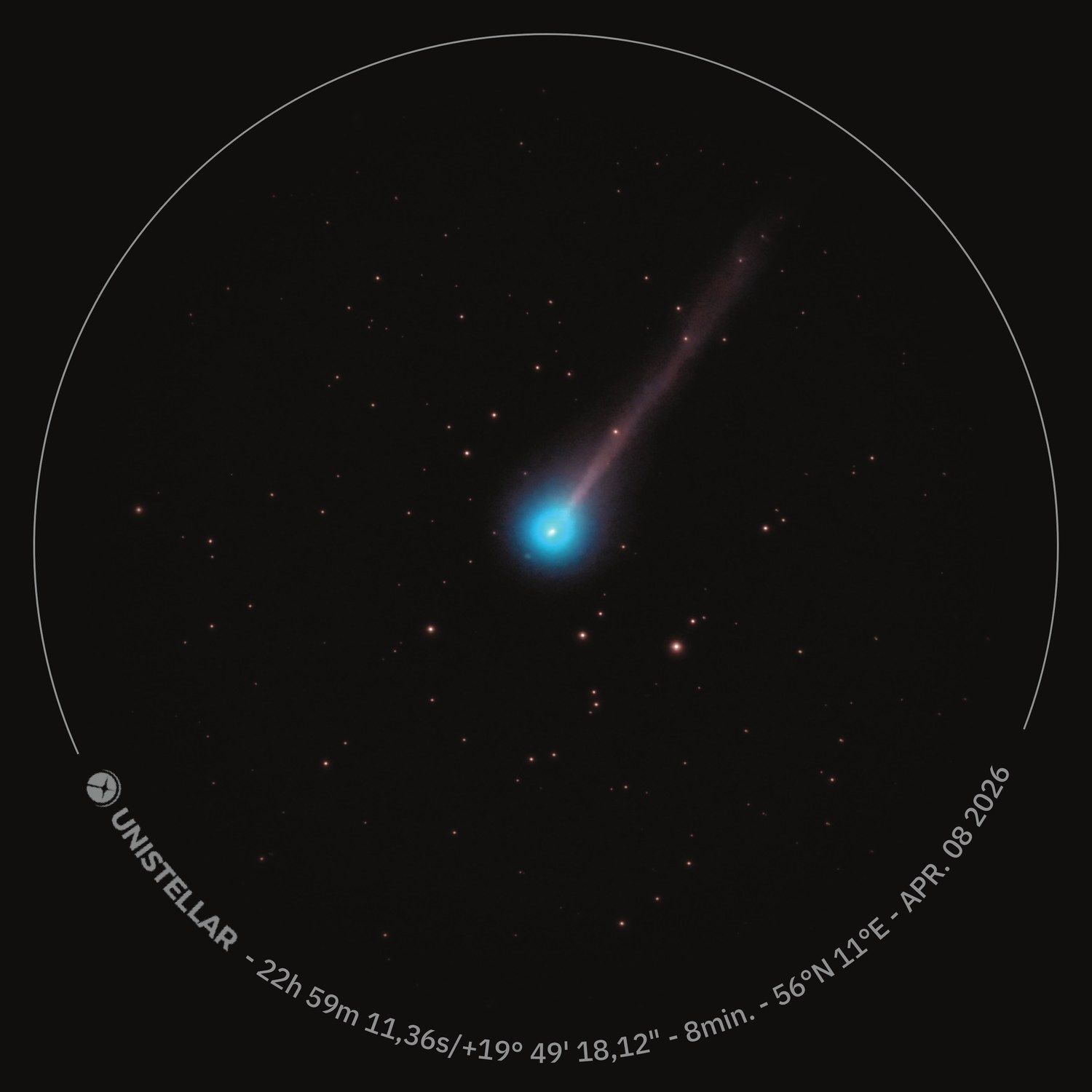 1
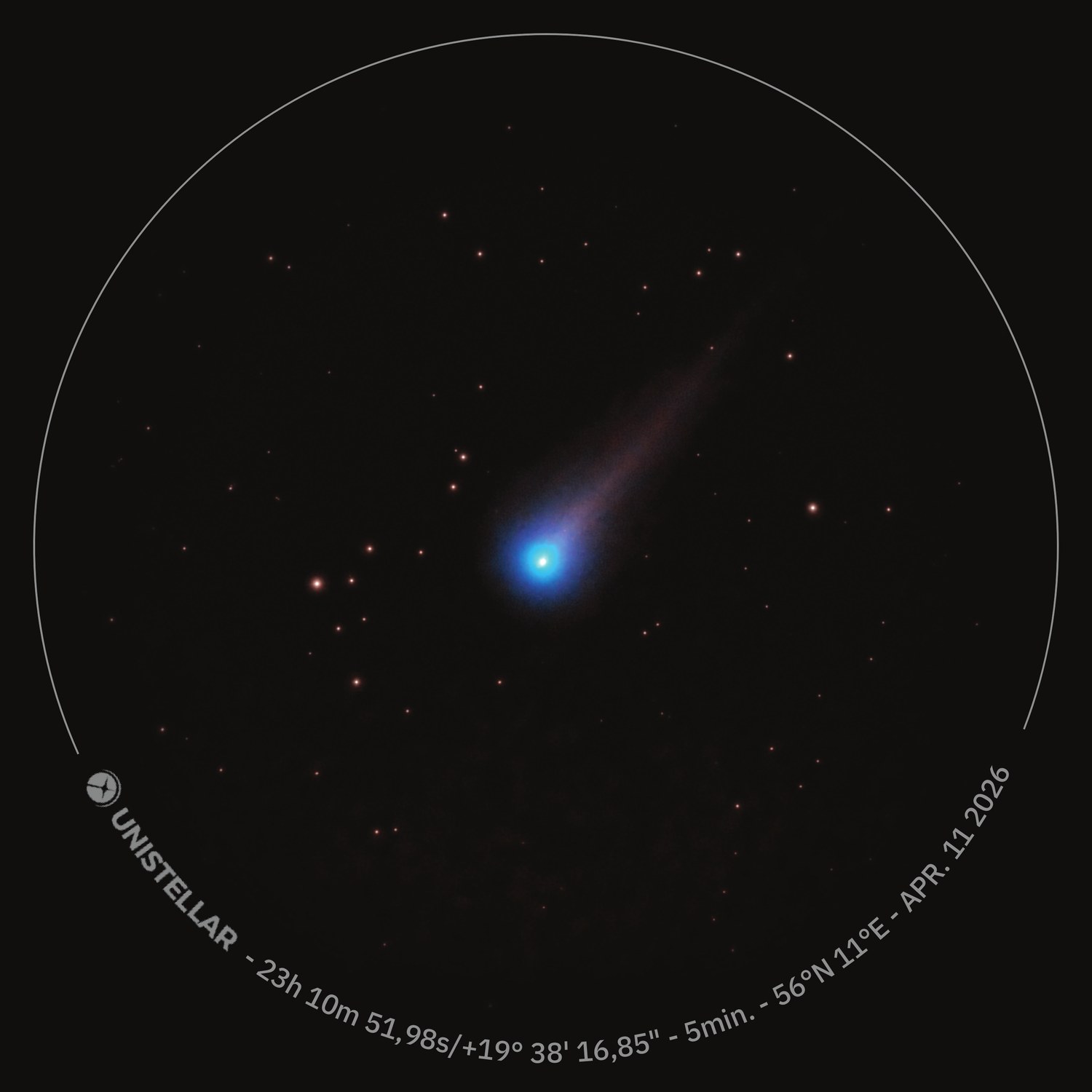 2
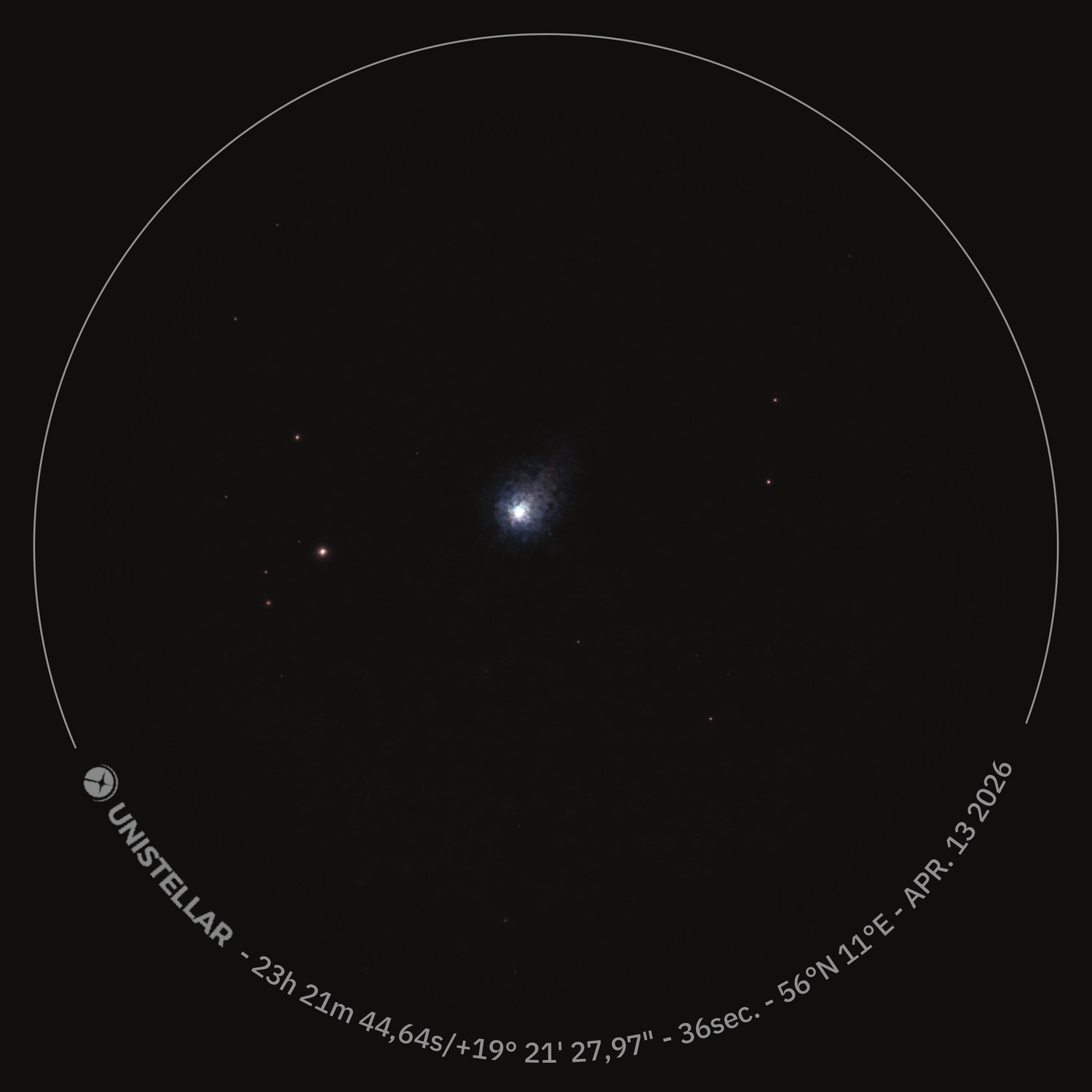 3
The third image is badly degraded — the comet appears smeared and diffuse — but the astrometric coordinates were rescued. This gave me the required time arc of 5 days.
From the first two images the comet had moved about 2.75° across the sky — an impressive angular velocity against the background stars. But two flat 2D images cannot separate the comet's own motion from the Earth's parallax. The two-body problem dictates that a full orbit determination requires at least three observations to solve for the six unknown Keplerian orbital elements.
The AI solves Gauss's orbit determination
To translate the three flat images into a 3D position I teamed up with an artificial intelligence. I fed the AI only my images and asked it to apply the method Carl Friedrich Gauss developed in 1801 to determine the orbit of the dwarf planet Ceres. That was enough.
Three lines of sight (ρ̂) from the Earth's known positions R₁,₂,₃ towards the comet's unknown 3D positions r₁,₂,₃.
Topocentric vectors
The coordinates of the images are rewritten as three unit vectors (ρ̂₁, ρ̂₂, ρ̂₃) pointing from the telescope towards the comet. The lengths of the vectors — the comet's true distance — are the unknowns.
The Earth's position
The AI determines the Earth's precise heliocentric 3D position at the three times (R₁, R₂, R₃).
Coplanarity
Since the comet follows a gravitational field around the Sun, its orbit must, according to Kepler's laws, be planar. The three space positions (r₁, r₂, r₃) must lie in the same plane — set up as a system of equations of linear combinations.
The iterative solution
Using the time differences, the AI sets up a matrix and iterates towards the distance — among other things by solving a complex polynomial of degree 8 that takes the Sun's gravity into account.
The process starts with a rough first guess, which is used to refine a new calculation — an iteration. I used a similar procedure with the Plasma Physics group at Risø in the summer of 1987 to determine the motion of a frozen deuterium pellet — fuel for the fusion process — which was to be fired into the JET fusion reactor outside Oxford. Back then I was dealing with polynomials of degree 6. Now it is degree 8.
What the three images revealed
The result of the AI's calculation was overwhelming. From three images taken in a Danish back garden, the model concluded that on 13 April the comet was:
An eccentricity slightly greater than 1 means that the orbit is an open hyperbola: the comet has reached escape velocity and will never return. We will never see it again.
Can you trust an AI?
To validate the calculations I immediately compared the results with the official, fully integrated orbit models from NASA's JPL Horizons system and orbit determination data from ESA. To my great satisfaction the AI's calculations — based on my backyard setup — agreed very well with the values of the big space agencies.
The official orbit
- Observations
- 523
- Time arc
- 194 days
- Eccentricity
- 1.0003398
- 1σ uncertainty
- 1.5 · 10⁻⁶
The backyard calculation
- Observations
- 3
- Time arc
- 5 days
- Distance
- 0.818 AU
- Speed
- 57.5 km/s
The official eccentricity is fixed at e = 1.0003398 with an incredibly low 1σ uncertainty of 1.4958 · 10⁻⁶. It is this precision — down to the sixth decimal place — built on a long observation arc, that makes astronomers certain that the number is above 1.
The official 1σ error margin (±0.0000015) is too small to draw here — the point lies safely in the hyperbola zone.
The Short Arc-problem
Although we hit the mark compared with ESA and NASA, the physics behind the result is more nuanced. Their models are built on hundreds of observations over many months. My model is built on three observations over just five days — and the last image was misty.
Two significant sources of error
Astrometric sampling uncertainty. My eVscope 2 has a resolution of 1.33 arcseconds per pixel. On the misty image, noise and lack of sharpness mean that the centre of the comet can easily be judged 3–4 pixels wrong — a local position error of up to 4–5 arcseconds.
Short observation arc. Over a span of only five days the comet's path is mathematically almost a completely straight line. Without curvature in the data the equations become hypersensitive, because the angles in the triangles become acute — and the error propagation enormous.
If you put the pixel error into the algorithm on the short five-day arc, the independent statistical uncertainty becomes:
If you asked the computer to calculate the eccentricity solely from my three images, the uncertainty would be massive — it could hardly determine with statistical certainty whether the orbit is a closed ellipse or an open hyperbola.
Is an error of 7.5 million km massive?
If ESA is to land a space probe on the comet, as they did with Rosetta, the answer is yes. But if we convert it into a relative percentage uncertainty, it corresponds to just a 6.1 % error in the distance measurement.
That with a consumer telescope in a hazy Danish back garden — assisted by artificial intelligence — you can measure the distance to a lump of ice 122 million km away with almost 94 % certainty is not a massive error. It is a massive educational success.
The distance to the comet determined from three backyard images — cross-checked against NASA and ESA.
The experiment proves the incredible power of AI combined with classical celestial mechanics, and makes an obvious project idea for cross-curricular courses between physics, mathematics and computer science. Teachers should embrace AI — there is enormous potential in this tool as a number cruncher.
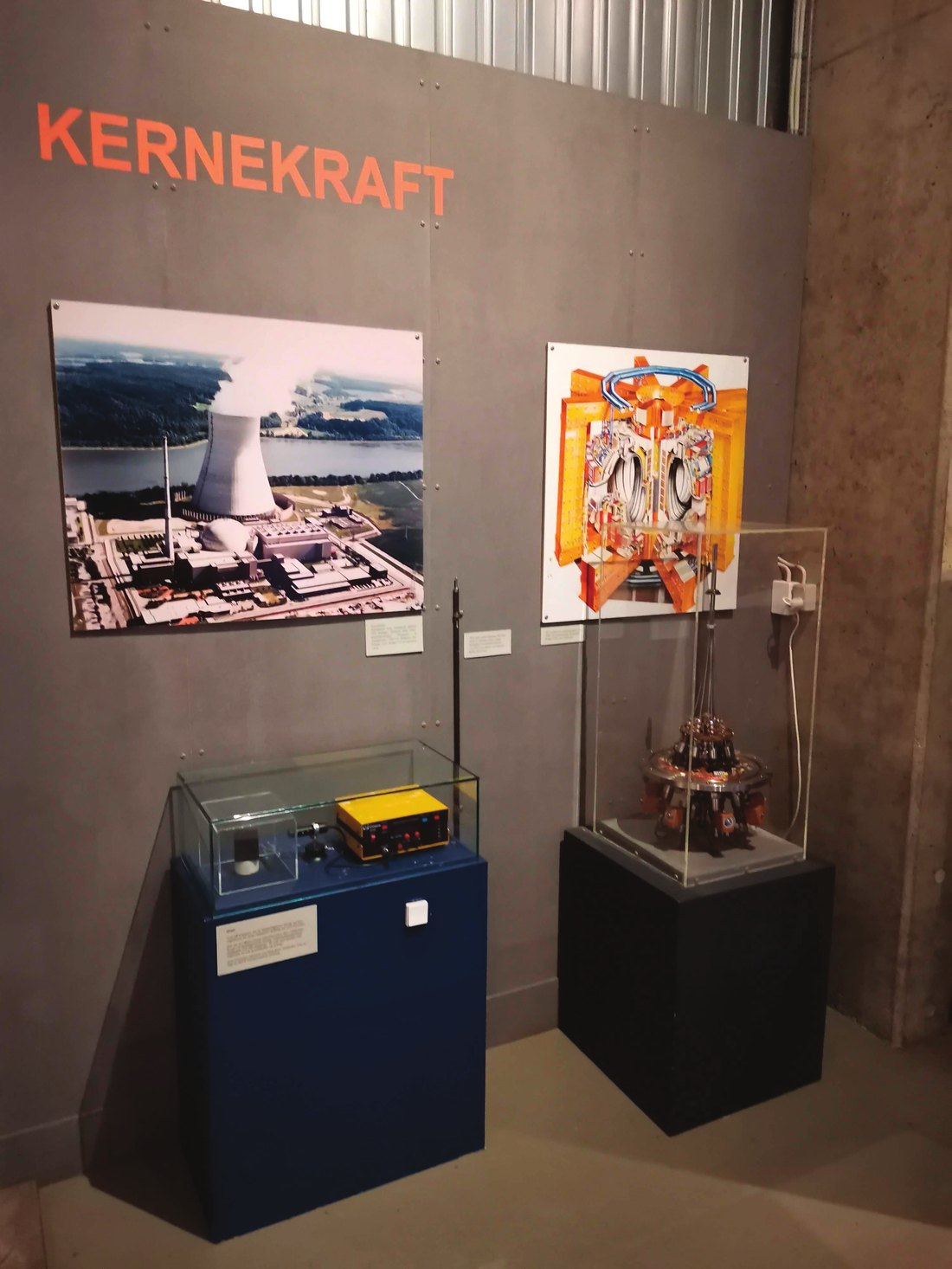
From deuterium pellets to comet orbits
The iterative method is not new to me. At Risø in 1987 we would have liked to achieve an injection speed of over 2 km/s for the deuterium pellet — but I found that it did not get above 1.8 km/s. Speed calculated as a derived quantity always penalises small measurement errors harder. A few years later I was proud to show the injection mechanism to a couple of my grandchildren on a trip to the Energy Museum.